COOLANT RESERVE TANK REMOVAL/INSTALLATION [PYUL]SM3329837
COOLANT RESERVE TANK REMOVAL/INSTALLATION [PYUL]

id01121a951300


D-code

• 15350

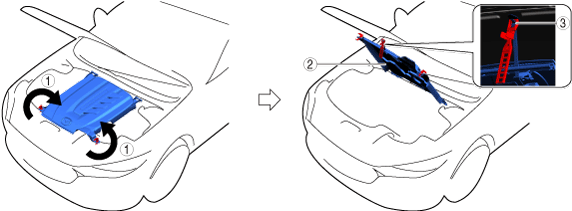
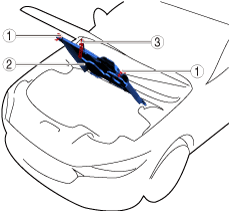
Open Capsule Cover

1.Open in the order indicated in the table.

ac6wzw00000012

Step

Part name

1
Rotating fastener
2
Capsule cover
3
Clip


Opening capsule cover note

1.Open the capsule cover as shown in the figure.

ac6wzw00000013

Symbol

Content

Servicing procedure


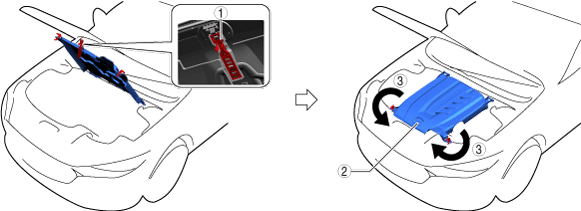
Closing capsule cover note

1.Close the capsule cover as shown in the figure.

ac6wzw00000014

Symbol

Content

Servicing procedure


Remove Cooling System Cap (Sub) (PYUL)

1.Remove in the order indicated in the table.

azzdjw00005276

Step

Part name

1
Cooling system cap (sub)


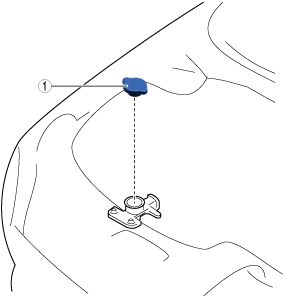
Remove Cooling System Cap

1.Remove in the order indicated in the table.

ac6wzw00000094

Step

Part name

1
Cooling system cap


Drain Engine Coolant (Main)

1.Open the coolant reserve tank cap.

azzdjw00007646

1
Coolant reserve tank cap

2.Drain the engine coolant (main) from the coolant reserve tank.

3.Remove the drain plug (main) and drain the engine coolant (main).

azzdjw00005248

1
Drain plug (main)

4.Install the drain plug (main).


Drain EV System Coolant

Warning
• The EV system is hot immediately after driving and charging, and can cause severe burns. Turn off the EV system and wait until it is cool before performing the servicing.
• If the cooling system cap is removed while the EV system is hot, hot coolant may be ejected, causing severe burns or injury. Perform the removal of the cooling system cap when the EV system is cool.
• When removing the cooling system cap, cover the cooling system cap with a clean cloth and remove it slowly.
• The cooling fan may suddenly start operating regardless of the main power switch position. Keep hands and tools away from the cooling fan even if the cooling fan is not operating to prevent injury, or damage to the cooling fan. When servicing the cooling fan or parts near the cooling fan, ensure the following.
― Do not perform charging
― Do not select high voltage battery cooling on center display after EV system stops
― Do not open/close doors frequently with main power switched OFF
― Access connected vehicle maintenance mode (MyMazda App connected vehicle)
― Cancel climate control timer
Note
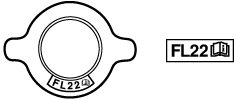
• If the [FL22] mark is shown on or near the cooling system cap, use Mazda Genuine FL22 EV system coolant.
acxuuw00002056
• FL22 type EV system coolant is shipped as a diluted solution. Use the solution as is when replacing coolant.

EV system coolant capacity (approx. quantity)

Capacity

9.6 L {10 US qt, 8.4 Imp qt}

1.Remove the cooling system cap.

ac6wzw00000094

1
Cooling system cap

2.Drain the EV system coolant from the coolant reserve tank (sub).

ac6wzw00000095

1
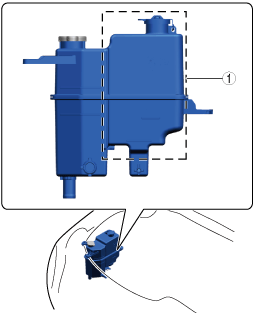
Coolant reserve tank (sub)

3.Remove the drain plug (sub).

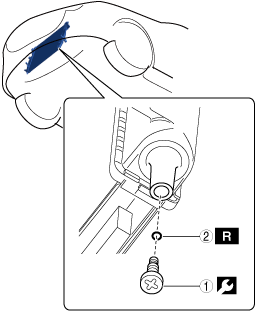
azzezw00000341

Symbol

Content

Servicing procedure
1 N·m {11 kgf·cm, 9 in·lbf}
Drain cock gasket

4.Draining the EV system coolant.

5.Install the radiator drain plug (sub).


Remove Engine Coolant Reserve Tank

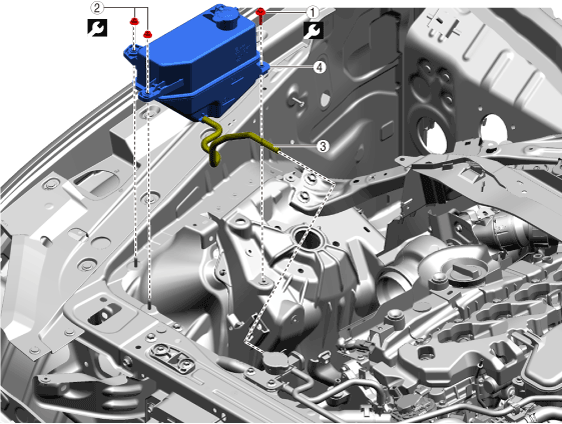
1.Remove using the procedure shown in the figure.

azzdjw00007067

Procedure

Part name

1
Bolt
9.5 N·m {95 kgf·cm, 82 in·lbf}
2
Nut
9.5 N·m {95 kgf·cm, 82 in·lbf}
3
Hose
4
Engine coolant reserve tank


Hose connection note

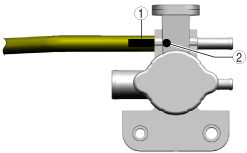
1.Connect the hose so that the projection is aligned with the marking.

azzdjw00007069

Symbol

Content

1
Marking
2
PROJECTION


Install in Reverse Order of Removal

1.Install in the reverse order of removal.


Add Engine Coolant (Main)

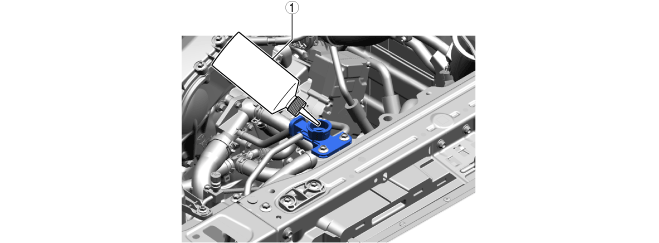
1.Add engine coolant (main) to the top surface of the radiator filler port.

azzdjw00007645

1
Bottle

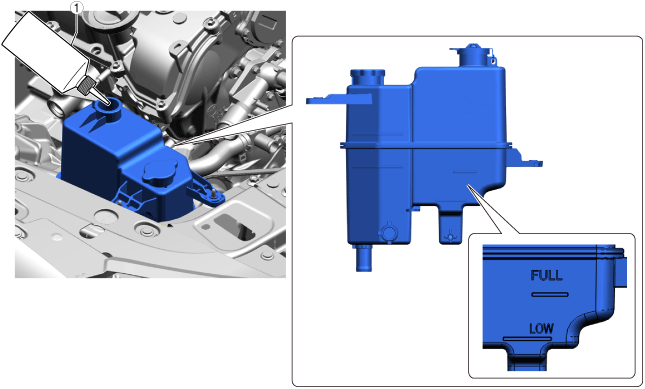
2.Add engine coolant (main) to the coolant reserve tank up to the FULL line.

azzdjw00007652

1
Bottle

Total coolant amount (reference)

Specification

Capacity

With e-SKYACTIV PHEV
8.6 L {9.1 US qt, 7.6 Imp qt}
Without e-SKYACTIV PHEV
7.0 L {7.4 US qt, 6.2 Imp qt}

3.After the engine coolant (main) is added up to the FULL line of the coolant reserve tank, add an additional 0.26 L {0.27 US qt, 0.23 Imp qt.}.


Perform Engine Coolant (Main) Air Bleeding (With e-SKYACTIV PHEV)

1.Perform the following procedure switch to compulsory engine start mode.

(1)Switch the ignition ON (Ready off) under the following conditions.
• Shift position: P position
• Brake pedal: Not depressed
(2)Depress and release the accelerator pedal 5 times with the brake pedal depressed.
(3)Release the brake pedal and depress the accelerator pedal again the same number of times.
(4)Depress the accelerator pedal the same number of times again while depressing the brake pedal again.
(5)Release the brake pedal.
(6)When the output limit warning light flashes 5 times, the preparation to switch to maintenance mode is competed.
• If the output limit warning light does not flash because the transition to maintenance mode has failed, switch the ignition OFF and verify if the implementation permit conditions are met. If there is no problem, repeat the procedure from Step 1.(See MAINTENANCE MODE.)
Note
• When the preparation for switching to maintenance mode is completed, maintenance mode is not completed even if the ignition is switched OFF.
• The mode returns to the transition preparation completion status by switching the ignition ON again after switching the ignition OFF.
(7)Depress the brake pedal again and switch the main power ON to switch to the desired mode.

2.Perform the engine coolant (main) air bleeding using the following procedure.

(1)Maintain the engine speed at approx. 2,000 rpm for 5 min.
(2)Maintain the engine speed at approx. 2,000 rpm for 10 s.
(3)Maintain idling for 30 s.
(4)Repeat Steps (2) and (3) 5 times.
(5)Maintain the engine speed at approx. 3,000 rpm for 10 s.
(6)Maintain idling for 30 s.
(7)Repeat Steps (5) and (6) 5 times.
(8)Increase the engine speed to approx. 4,000 rpm, and then idle.
(9)Maintain the engine speed at approx. 2,000 rpm for 10 s.
(10)Maintain idling for 30 s.
(11)Repeat Steps (2) to (10) until the air is bled out.

3.Stop the engine and wait until the engine coolant (main) temperature decreases.

4.If the engine coolant (main) level is low, add engine coolant (main) and inspect the coolant amount.


Bleed Coolant (Sub) Air (With e-SKYACTIV PHEV)

1.Verify that the coolant system cap (sub) is securely closed.

2.Perform the following procedure within 60 s and switch to air bleeding mode.

(1)Switch the main power ON (READY off).
(2)Release and depress the accelerator pedal 5 times.
(3)Release and depress the brake pedal 10 times.
(4)Switch the main power ON (READY on).
(5)Verify that [Air Bleeding Mode] is displayed in the instrument cluster or on the center display.
• If the liquid level in the coolant reserve tank decreases during air bleeding mode and air becomes mixed in, switch the ignition OFF, and then repeat Steps (1) to (5).

3.After completing air bleeding mode, verify the height of liquid surface in the coolant reserve tank.

Coolant (sub) liquid surface is F line or less
• Remove the coolant system cap (sub), replenish the coolant (sub) up to the F line, and switch to air bleeding mode again.
Coolant (sub) liquid surface is F line
• If there is neither no change in the liquid surface nor bubbles in the coolant reserve tank, the air bleeding is completed.
Note
Air bleeding mode cancellation conditions
• Air bleeding mode elapses for 900 s.
• Changes to a position other than the P position.
• Switch the main power OFF.

4.Inspect the coolant (sub).

5.If the coolant (sub) level is low, add coolant (sub) and perform air bleeding again.


Inspect For Engine Coolant Leakage

Warning
• A hot engine can cause severe burns. Turn off the engine and wait until it is cool before performing the servicing.
• If the engine cooling system cap is removed when the engine is hot, steam and boiling water may be ejected, causing severe burns or severe injury. Perform the removal of the engine cooling system cap when the engine is cool.
• When removing the engine cooling system cap, cover the engine cooling system cap with a clean cloth and remove it slowly.
Note
• Perform the procedure with the engine cooling system cap removed.

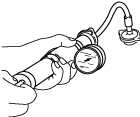
1.Install the radiator cap tester to the filling port.

ampjjw00003132

2.Apply pressure using the radiator cap tester.

Coolant leakage inspection pressure
122.6 kPa {1.250 kgf/cm2, 17.78 psi} [1 min]

3.When pressurizing the radiator, verify that the pressure is maintained.

• If the pressure decreases, repair or replace the location where water is leaking because water leakage can be considered.


Install cooling system cap (sub)

1.Remove in the order indicated in the table.

azzdjw00005277

Step

Part name

1
Cooling system cap (sub)


Install cooling system cap

1.Install in the order indicated in the table.

ac6wzw00000094

Step

Part name

1
Cooling system cap